

In real life we don’t just hear what is making a sound: we also hear where it comes from, how far away it is and what kind of space we are in. Spatial audio is the set of techniques that capture and reproduce this information, so that listeners perceive a believable three-dimensional sound scene, over loudspeakers or headphones.
How we tell where a sound comes from
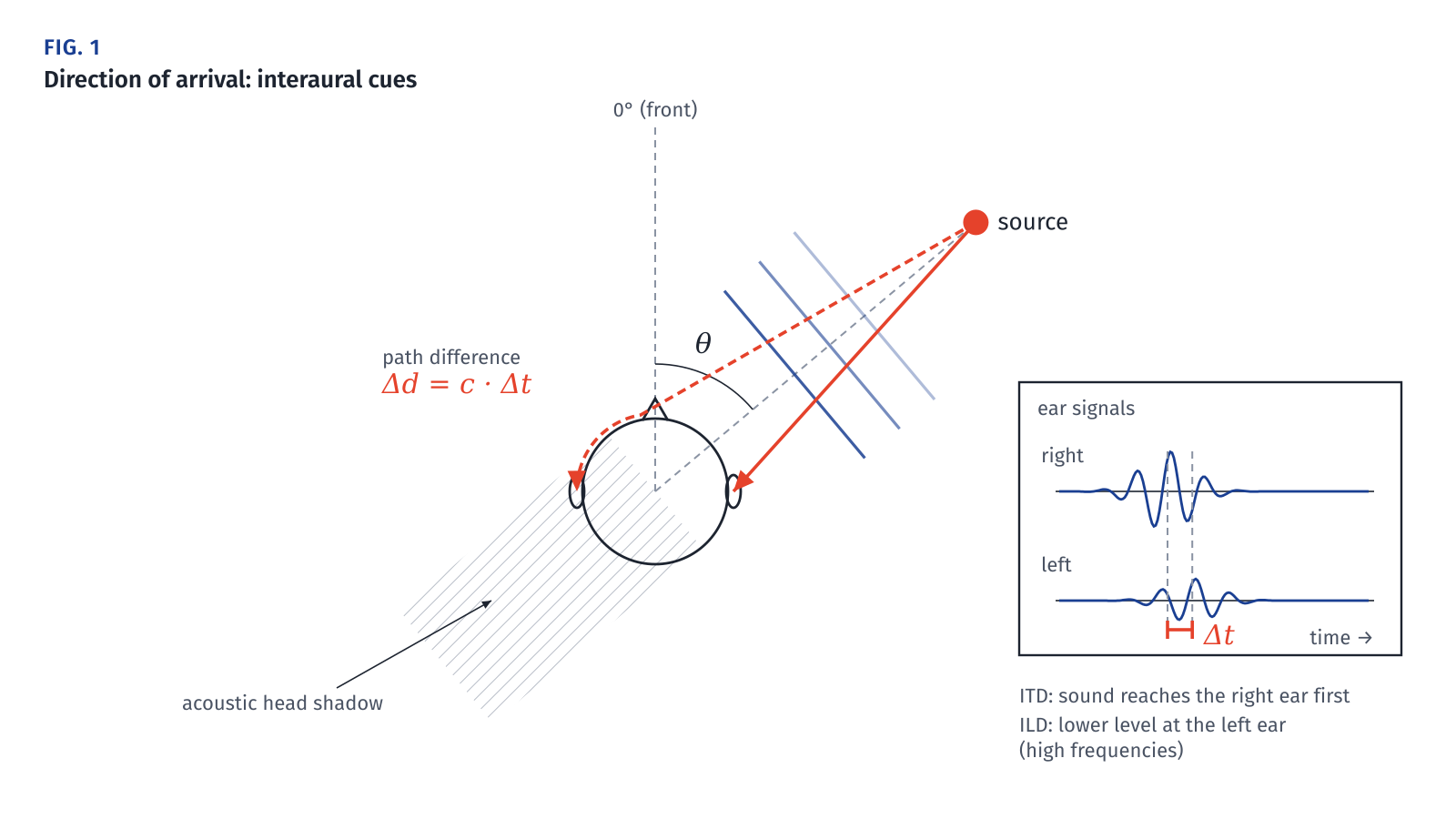
The brain estimates a sound’s direction of arrival (DOA) by comparing what reaches the two ears:
- Interaural time difference (ITD): a sound coming from the right reaches the right ear a fraction of a millisecond before the left. This is the main cue at low frequencies.
- Interaural level difference (ILD): the head shadows high frequencies, which arrive weaker at the far ear.
- Spectral cues: the outer ear, head and torso filter sound differently for every direction. This personal “filter”, the HRTF (Head-Related Transfer Function), lets us tell above from below and front from back.
- Head movements: even small head turns change the cues, and the brain uses this to resolve ambiguities, such as a source in front versus behind.
For distance, the main cues are level, the ratio between direct and reverberant sound, and the early reflections from the room.
Externalization
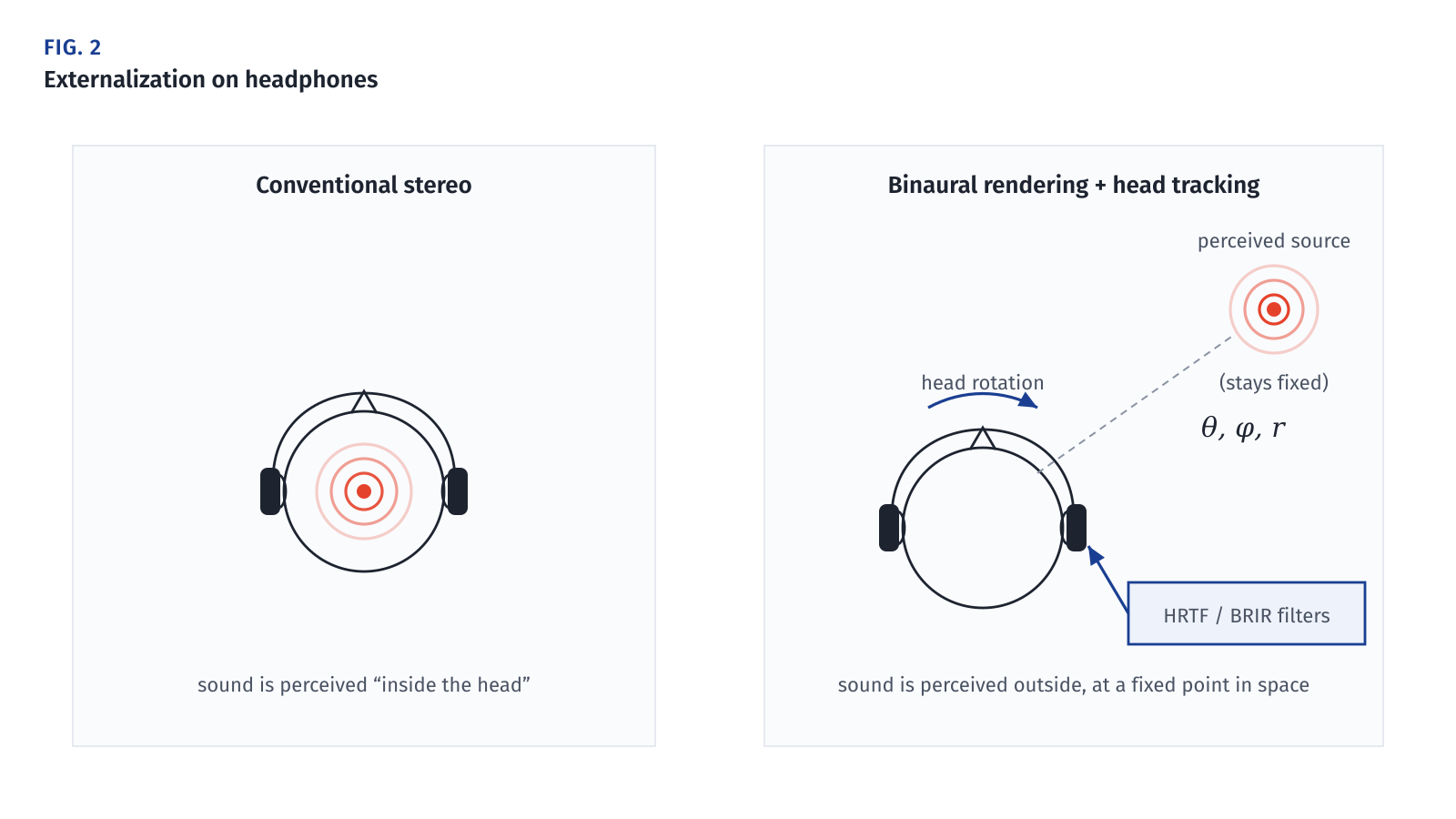
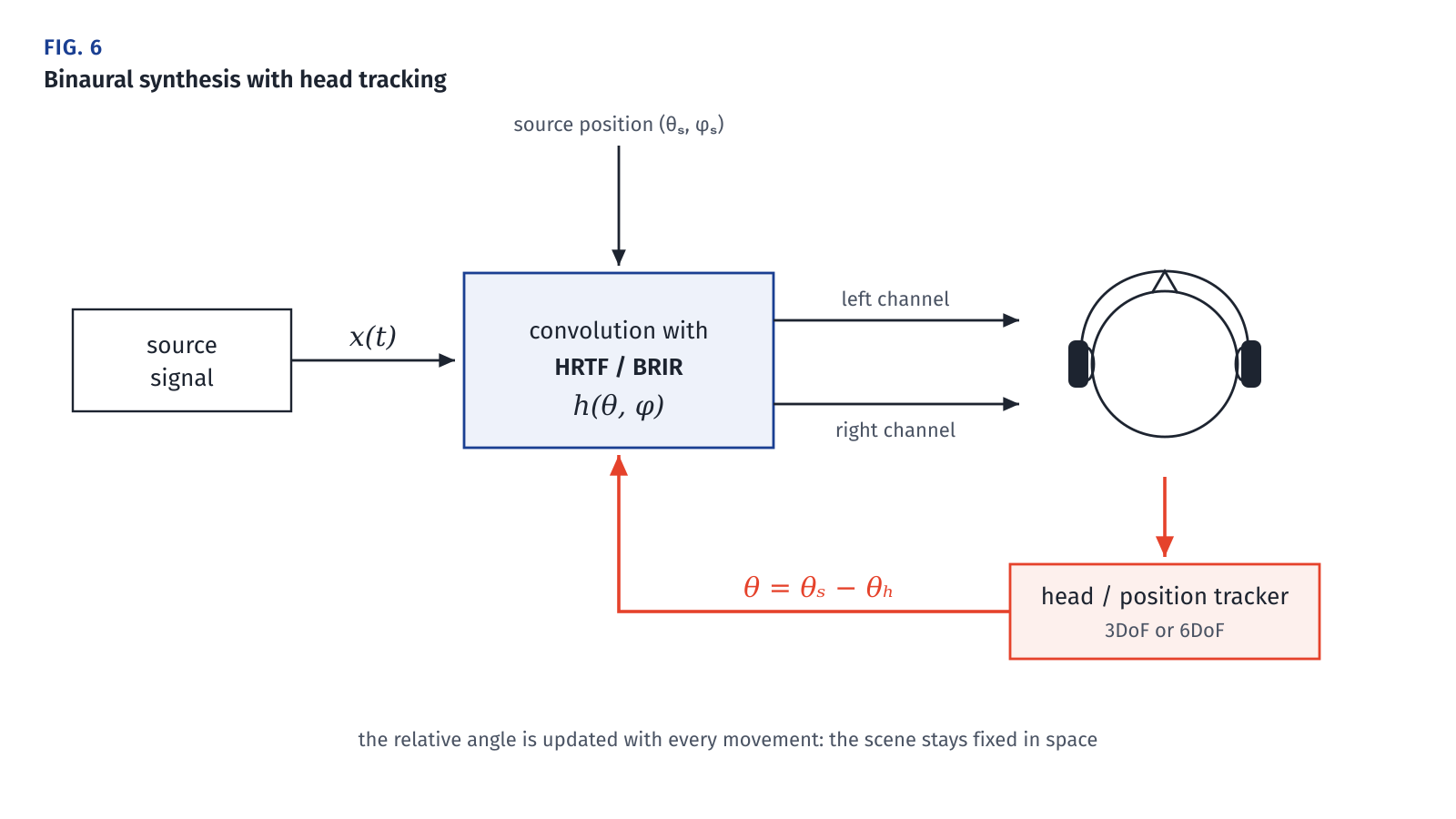
On headphones, an ordinary stereo track seems to play “inside your head”. Externalization is the opposite: sounds are perceived outside the head, at precise points in the space around the listener. It takes three ingredients: HRTF filters that suit the listener, reverberation consistent with the space being represented, and head tracking, so that sources stay fixed in space when the listener turns. When position is tracked as well as orientation (6DoF, six degrees of freedom), listeners can even walk through the sound scene.
Capturing the sound field: microphone arrays
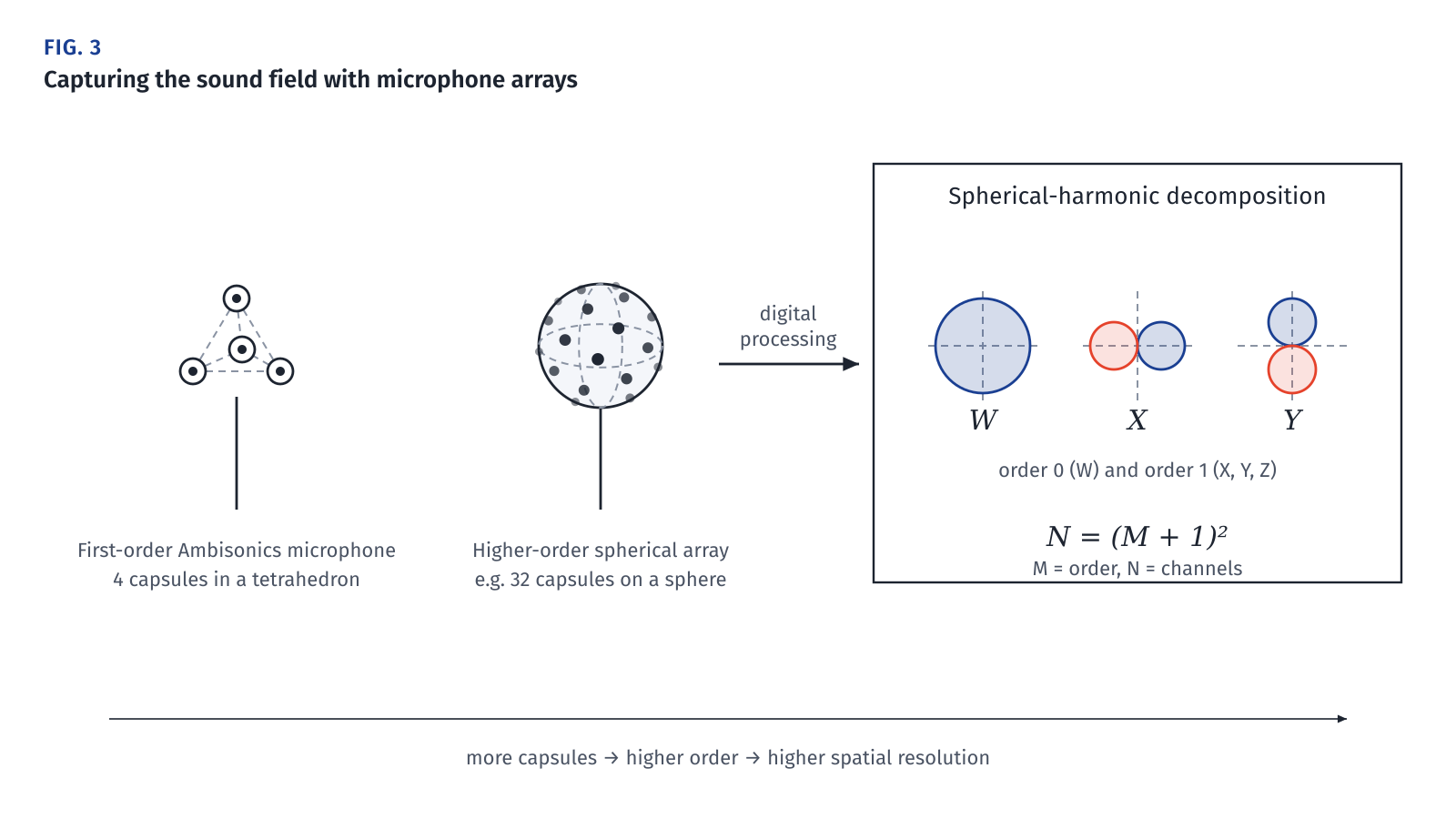
A single microphone records sound at one point but loses almost all directional information. Microphone arrays use many capsules in a known geometry, usually on a sphere:
- First-order Ambisonics microphones: four capsules in a tetrahedron, describing the sound field with four channels (B-format).
- Higher-order spherical arrays: dozens of capsules, reaching 3rd, 4th order and beyond, with much higher spatial resolution.
- Binaural dummy heads: microphones in the ears of a mannequin, recording what would reach the eardrums.
From the capsule signals, digital processing derives the spherical-harmonic decomposition of the sound field, acoustic maps and directional beams (beamforming). The same principle is used to measure the impulse responses of a room or a car cabin, for example with the exponential sine sweep method developed by Angelo Farina at the University of Parma: responses that capture not only the acoustics of the space but also the direction of every reflection.
Reproducing sound over loudspeakers
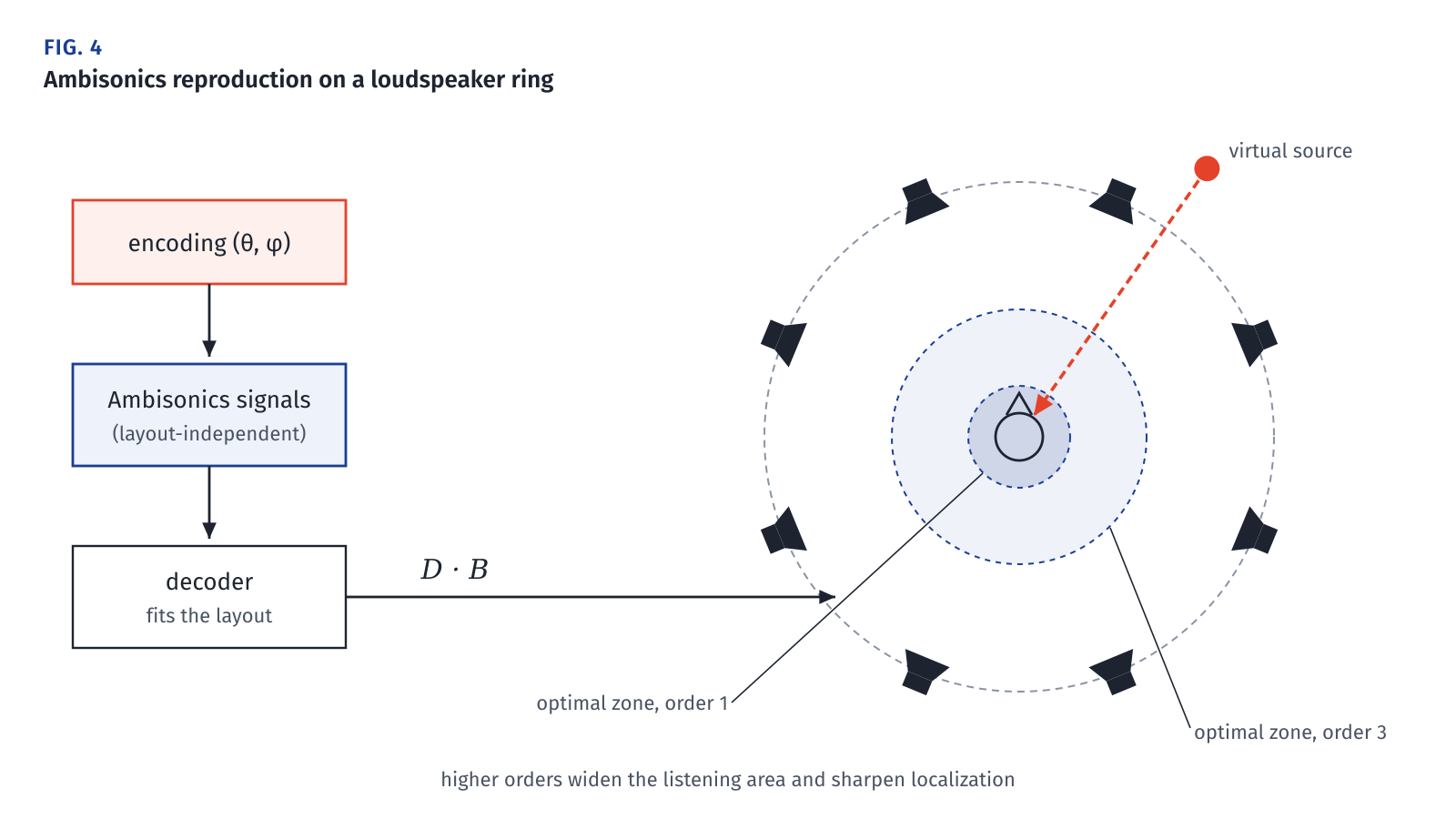
- Ambisonics: the sound field is described independently of the loudspeakers, as a sum of spherical harmonics. A decoder then adapts it to any loudspeaker layout around the audience (circles, domes, multiple rings). The higher the order, the sharper the localization and the larger the optimal listening area.
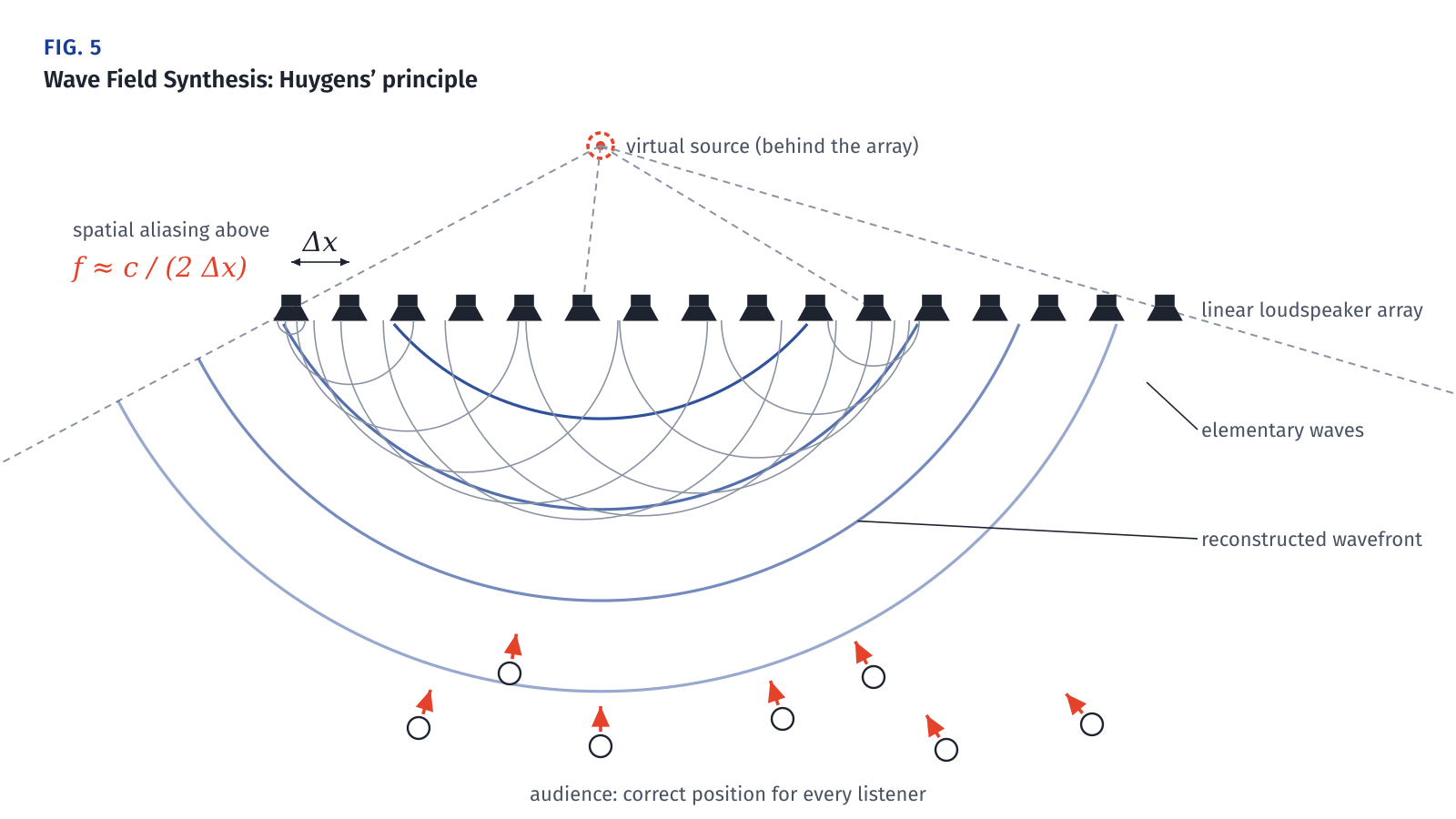
- Wave Field Synthesis (WFS): based on Huygens’ principle. Rows of many closely spaced loudspeakers rebuild the wavefront of a virtual source, which stays in the same place for the whole audience, not just for those in the centre. Sources can be placed behind the loudspeakers or even in front of them, inside the room. The main limit is spatial aliasing at high frequencies, which depends on the loudspeaker spacing.
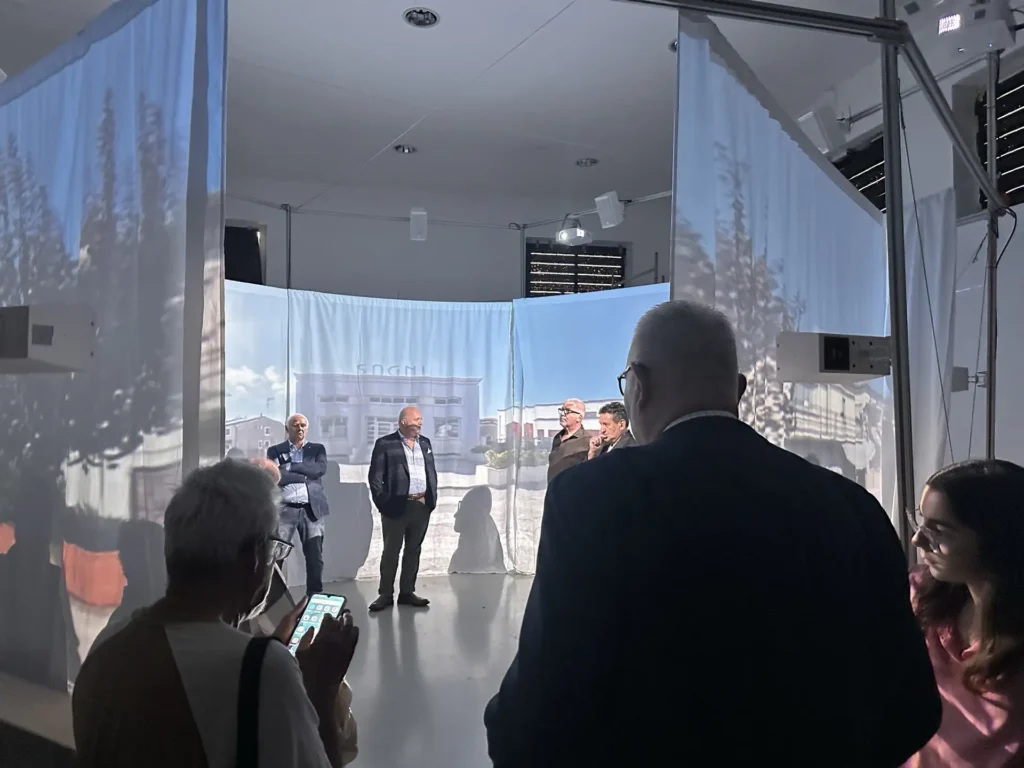
The two approaches complement each other, which is why we use them together in our immersive rooms.
Reproducing sound over headphones
Headphones use binaural synthesis: each source is filtered with the HRTFs for its direction, or with binaural room impulse responses (BRIRs) measured in a real room. A whole Ambisonics sound field can be rendered on headphones through “virtual loudspeakers”. With head and position tracking, the scene stays stable and consistent as the listener moves, just as in virtual reality.
ZOTech’s approach: physics, not just effects
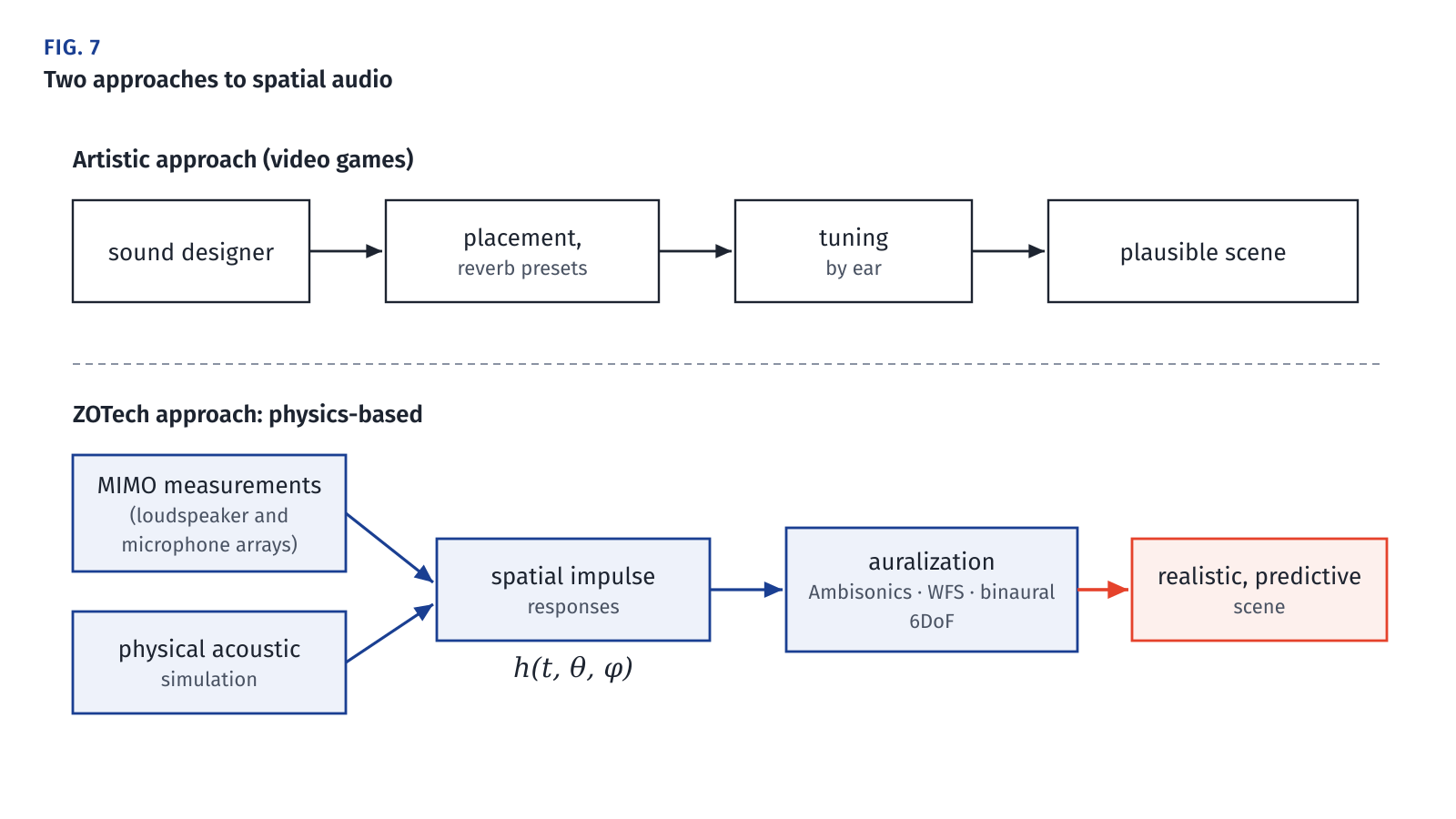
In video games and many multimedia productions, spatial audio is mostly an artistic job: sound designers place sources, pick reverbs from presets and tune attenuation and effects by ear. The result is often effective and immersive, but it does not aim to be accurate: a space sounds the way the designer decided, not the way it would really sound.
ZOTech starts from physics instead:
- Real measurements: we measure rooms, car cabins and sound systems with loudspeaker and microphone arrays (MIMO), obtaining spatial impulse responses that objectively describe how sound travels.
- Physically correct models: when a space does not exist yet, we simulate it with acoustic models based on real sound-wave propagation and material properties.
- Faithful reproduction: measurements and simulations become auralizations in Ambisonics, WFS or binaural, including 6 degrees of freedom, in a listening room or in virtual reality.
The result is realistic, reliable spatial audio that can support real decisions: hearing a sound system before it is installed, comparing options for a car or a venue, trying a product before buying it.